WELCOME TO APV2025
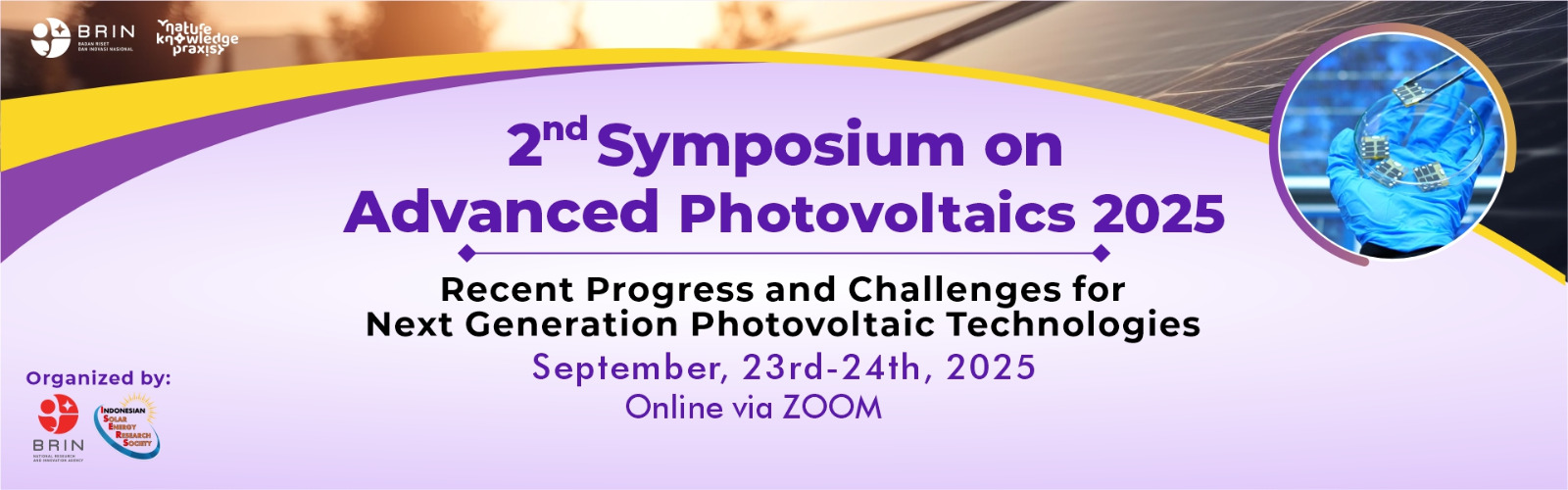
“About SIMPOSIUM APV 2025”
A photovoltaic device, or more commonly known as a solar cell, is a technology that directly converts light into electricity through absorption of photon energy via the band energy gap of semiconductor materials. It is promising as an alternative future energy source because of its renewable nature, environmentally friendly attributes, low cost, and ability to provide independent energy resources. Recently, the development of photovoltaic (PV) technology has been progressing significantly from lab to fab. The first crystalline silicon with power conversion energy of 6% was envisioned by Bell Lab in 1954 and now it has exceeded 27% for silicon based solar cells. Meanwhile, Indonesia has huge natural resources as feedstock to third generation PV technologies such as titanium, tin, lead, and copper. At the same time, Indonesia as a tropical country faces challenging environmental conditions for photovoltaic device fabrication which requires controlled environment such as low humidity and cool temperatures. In this regard, lessons learned from studies reported from universities and research institutions abroad need to be adapted to local environments. Nevertheless, connecting to key researchers globally are needed to allow knowledge exchange as much as fostering networks among Indonesian photovoltaic researchers to raise the quality of advanced PV research in Indonesia collectively.
Before 2023, there was no domain-specific forum of researchers dedicated to advanced photovoltaic technologies. We then initiated a symposium on advanced photovoltaics sponsored by National Research and Innovation Agency Republic of Indonesia or Badan Riset dan Inovasi (BRIN) Indonesia in 2023. The first symposium was conducted hybrid and attracted 170+ registered participants from 5 countries including Indonesia with about 50 participants attended offline at BRIN. During the first symposium, there are 3 keynote speakers, 6 invited speakers and 8 young scientist presenters. The 2023 symposium was concluded with the launching of Indonesian Solar Cell Research Society, an Indonesian scientific community dedicated for solar cell enthusiast. Reflecting on the huge enthusiasm and acceptance of our first conference two years ago, Research Center for Electronics, BRIN & Indonesian Solar Energy Research Society (ISERS) will organize the 2nd symposium on advanced photovoltaics in full online format to accommodate more participants both locally and globally. We foresee this symposium as a flagship platform of knowledge exchange for advanced PV materials and device researchers. Objectives
The objectives of the 2nd Symposium on Advanced Photovoltaics 2025 are as follows.
1.To open a global network of Indonesian researchers who actively engage in photovoltaic research either among domestic or overseas researchers;
2.To provide a platform for knowledge sharing, synergy and collaboration to advance the photovoltaic research in Indonesia; and
3.To facilitate technical discussion related to advanced photovoltaics, such as emerging technologies, novel materials, performance improvement, and reliability enhancement.
More details about ISERS’ activities and committee can be found in https://solarenergyresearchsociety.wordpress.com/
Scope
The symposium will cover topics on advanced photovoltaics but not limited to :
- Integrated photovoltaics devices
- Thin film photovoltaics: CZTS, CIGS and other Kesterites
- Emerging solar cells technologies, such as organics solar cells, dye sensitized solar cells, perovskite solar cells, quantum dots solar cells, tandem solar cells, and other novel approaches
- Modelling and simulation of molecules, material and devices
- Emerging concepts and methods in solar energy conversion
- Manufacturing and scalability, such as scale-up manufacturing processes, roll-to-roll fabrication, printable solar cells, and other scale-up manufacturing techniques that provide for industrialization/commercialization.
- Performance improvement and durability, such as strategies for enhancing performance, stability, reliability, encapsulation, advanced passivation strategies, anti-reflection coatings, and approaches to mitigate degradation mechanisms.
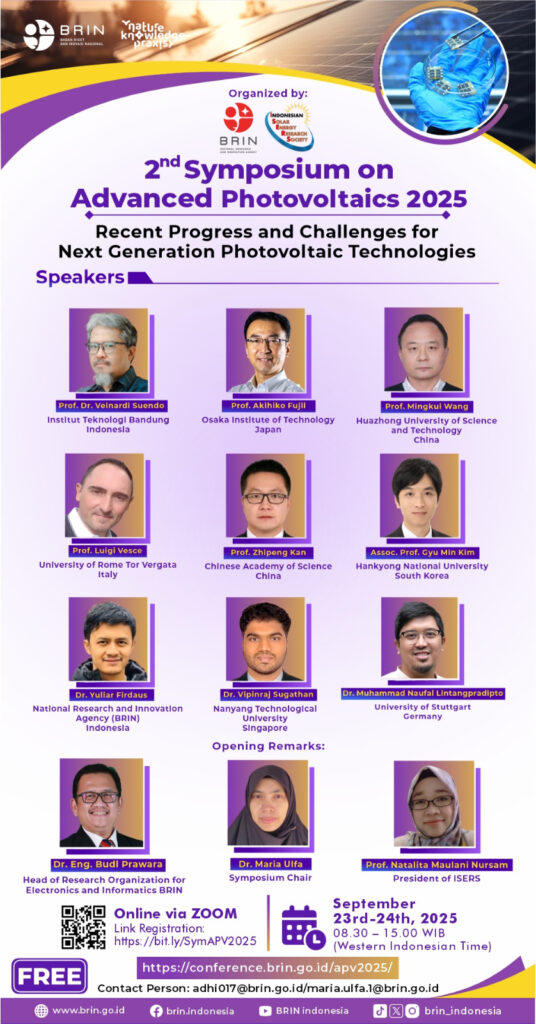
Speakers

Prof. Dr. Veinardi Suendo
Chemistry Department, Faculty of Mathematics and Natural Sciences
Institut Teknologi Bandung, Indonesia
Title : The Main Challenges in PV Fabrication and Materials Design
His research interests include the development of new organic electronics materials based on porphyrins, anthocyanins, nano carbons, and polyaniline. These cover their optoelectronic properties, synthesis route, chemical modification, wet-process device fabrications, and molecular spectroscopies.

Asst. Prof. Luigi Vesce
Centre for Hybrid and Organic Solar Energy (CHOSE)
Department of Electronic Engineering
University of Rome Tor Vergata, Italy
Title : Thin film perovskite photovoltaic technology: from lab cells to scalable printed modules
His research activity deals with the discovery, development, and fabrication by coating/printing techniques, and scaling-up of efficient and stable dye sensitized and perovskite solar technologies for outdoor and indoor applications.

Assoc. Prof. Gyu Min Kim
Department of Chemical Engineering
Hankyong National University, South Korea
Title : Advancements in Perovskite Solar Cells: From Dopant Free Hole Transport Materials to Stability-Enhanced Hybrid Perovskites
His research focuses on developing advanced optoelectronic devices, especially perovskite and dye-sensitized solar cells, with emphasis on lead-free materials, nanomaterial integration, practical implementation and environmentally friendly electrode alternatives. His laboratory connects core materials science with real-world device fabrication and scaling.

Dr. Yuliar Firdaus
Advanced Photovoltaics and Electronic Devices Research Group
Research Center for Electronics
Research and Innovation Agency (BRIN), Indonesia
Title : Functional Interlayers: Tuning Interfaces for Single Junction and Multijunction Organic Solar Cell Devices
His research focuses on organic, hybrid, dye-sensitized and perovskite solar cell technologies. By integrating experimental work, optical characterization, computational simulations, and applied research—with a strong focus on sustainable materials—he develops advanced photovoltaic systems tailored for practical applications.

Dr. Vipinraj Sugathan
Postdoctoral researcher
Nanyang Technological University, Singapore
Title : Lead Free Perovskites--The need and the road ahead
His research focuses on organic, hybrid, dye-sensitized and perovskite solar cell technologies. By integrating experimental work, optical characterization, computational simulations, and applied research—with a strong focus on sustainable materials—he develops advanced photovoltaic systems tailored for practical applications.

Prof. Akihiko Fujii
Osaka Institute of Technology, Japan
Title : Uniaxial coating for organic-inorganic halide perovskite thin films and its solar cell application
His research centers on combining advanced material processing with device engineering, ranging from the nanoscale design of aligned semiconductor films to their application in emerging printed electronics, especially in high-performance solar cells and flexible electronic systems. His research interests include oriented 2D/3D perovskite solar cells.

Prof. Mingkui Wang
Huazhong University of Science and Technology, China
Title : Efficient and stable perovskite solar cells
His research focuses on next-generation solar energy technologies, particularly perovskite and dye-sensitized solar cells, photoelectrochemistry, and optoelectronic interfaces. Prof. Wang is recognized as a leading scientist in materials science and renewable energy, contributing significantly to advancing the stability and efficiency of perovskite solar cells through innovative material design and device integration strategies.

Prof. Zhipeng Kan
Chongqing Institute of Green and Intelligent Technology
Chinese Academy of Sciences (CAS) Chongqing China
Title : Bilayer Organic Solar Cells
He has contributed significantly to research in organic electronics, especially organic semiconductors and solar cell devices.

Dr. Muhammad Naufal Lintang Pradipto
Postdoctoral Researcher
Institute for Photovoltaics, University of Stuttgart, Germany
Title : Single-Crystal Perovskites: Unlocking the Next Generation of Solar Cell Efficiency
He is a researcher at the Functional Nanomaterials Lab (FuNL). His research focuses on hybrid perovskite solar cells, quantum dot materials, and perovskite single crystals, contributing to the development of advanced materials and device strategies for next-generation photovoltaic technologies.
Program
Day 1 (Tuesday – September 23rd, 2025), time in GMT+7
08.00 – 08.30 : Connect to the virtual meeting room (online)
Link Zoom (shared to all presenters and participants by
email)
08.30 – 08.45 : Opening and Introduction of Symposium Agenda
Indonesian Anthem
Welcoming speech from:
1. Dr. Maria Ulfa (Chairman of the committee)
2. Prof. Dr. Natalita Maulani Nursam (President of ISERS)
3. Dr. Eng. Budi Prawara (Head of Research Organization
for Electronics and Informatics, BRIN)
Session 1
Session Chair : Prof. Dr. Natalita Maulani Nursam
(Research Center for Electronics, BRIN)
08.45 – 09.30 : Speakers 1
Prof. Dr. Veinardi Suendo
(Institut Teknologi Bandung, Indonesia)
The grand perspective of solar cell technology nowadays
09.30 – 10.15 : Speakers 2
Prof. Mingkui Wang
(Huazhong University of Science and Technology, China)
Efficient and stable perovskite solar cells
10.15 – 10.30 : Morning Break
Session 2
Session Chair : Dr. Adhita Asma Nurunnizar
(Research Center for Electronics, BRIN)
10.30 – 11:15 : Young Scientist Talk
Setiyadi Tri Utomo, S,Si (ITB, Indonesia)
Polymer Donor-Driven Antisolvent Strategy for Lead-halide
Perovskite Solar Cells with Printable Carbon Electrodes
Rossyaila Matsna Muslimawati, M.Si (ITB, Indonesia)
Tin-Based Perovskite Solar Cells: Insights from Additives
and Simulations
Muhammad Asharuddin (ITB, Indonesia)
The Influence of Bromide/Iodide Ratio on the
Photoluminescence Characteristics of Colloidal Multiple Anion
Cesium Lead Halide Perovskite Nanocrystals
11.15 – 12.00 : Speakers 3
Prof. Akihiko Fujii (Osaka Institute of Technology, Japan)
Uniaxial coating for organic-inorganic halide perovskite thin
films and its solar cell application
12:00 – 13.30 : Lunch Break
Session 3
Session Chair : Dr. Bening Tirta Muhammad
(Research Center for Electronics, BRIN)
13:30 – 14.15 : Speakers 4
Dr. Vipinraj Sugathan
(Nanyang Technological University, Singapore)
Lead Free Perovskites – The need and the road ahead
14:15 – 15.00 : Speakers 5
Prof. Luigi Vesce (University of Rome Tor Vergata, Italy)
Thin film perovskite photovoltaic technology: from lab cells to scalable printed modules
15:00 – 15:10 : Closing Day #1
Day 2 (Wednesday – September 24th, 2025), time in GMT+7
08.30 – 09.00 : Connect to the virtual meeting room (online)
Link Zoom (shared to all presenters and participants)
Session 4
Session Chair : Dr. Widhya Budiawan
(Research Center for Electronics, BRIN)
09.00 – 09.45 : Speakers 6
Dr. Yuliar Firdaus
(National Research and Innovation Agency, Indonesia)
Functional Interlayers: Tuning Interfaces for Single Junction and Multijunction Organic Solar Cell Devices
09.45 – 10.30 : Speakers 7
Prof. Zhipeng Kan (Chinese Academy of Science, China)
Bilayer Organic Solar Cells
10.30 – 10.45 : Morning Break
Session 5
Session Chair : Dr. Wilman Septina
(Research Center for Electronics, BRIN)
10.45 – 11.15 : Young Scientist Talk
Annisa Nandhita Kurniawati, S.Si (ITB, Indonesia)
Crystallization Behavior of Ambient-Air Processed CsPbBr3
Thin Films on Various Electron Transport Layers and Its
Impact on Solar Cells Performance
Dr. Junivan Sulistianto (UI, Indonesia)
Improving Ambient Processed Carbon-based Perovskite Solar
Cells Using CuSCN Additive in Carbon Electrodes
11.15 – 12.00 : Speakers 8
Assoc. Prof. Gyu Min Kim
(Hankyong National University, South Korea)
Advancements in Perovskite Solar Cells: From Dopant Free
Hole Transport Materials to Stability-Enhanced Hybrid
Perovskites
12.00 – 13.30 : Lunch Break
Session 6
Session Chair : Dr. Nunik Nurhayati
(Research Center for Electronics, BRIN)
13.30 – 14.15 : Young Scientist Talk
Ihsanul Mubarok (UNPAD, Indonesia)
Water-Based Perovskite CsPbBr3 Solar Cells
Dini Setiyani, M.Sc (UGM, Indonesia)
Probing Interfacial Charge Transport & Optical Dieletric
Properties in TiO2/CsPbBr3 Films via Spectroscopic Ellipsometry
Fry Voni Steky, M.Si (ITB, Indonesia)
Investigation on PEO Composition in I⁻/I₃⁻ Redox Electrolyte for
Enhanced DSSC Performance
14.15 – 15.00 : Speakers 9
Dr. Muhammad Naufal Lintang Pradipto
(University of Stuttgart, Germany)
Single-Crystal Perovskites: Unlocking the Next Generation
of Solar Cell Efficiency
15.00 – 15.10 : Closing Remarks
Prof. Yusuf Nur Wijayanto, Ph.D.
(Head of Research Center for Electronics)
Venue and Registration
Date : September 23rd-24th, 2025
Time : 08.30 – 15.00 WIB
Venue : Online Zoom Meeting
Participants who wish to attend the symposium may click the button below.
Young Scientist Talks
The 2nd Symposium on Advanced Photovoltaics 2025 provides an opportunity for early-career researchers, fresh graduates, graduate students, or undergraduate students to present their research works in the field of photovoltaics, which are within the scope of this symposium.
Fry Voni Steky, M.Si
Chemistry, Institut Teknologi Bandung, Bandung
Rossyaila Matsna Muslimawati, M.Si
Advanced Functional Materials Research Group, Institut Teknologi Bandung, Bandung
Muhammad Asharuddin, M.Si
Physics, Institut Teknologi Bandung, Bandung
Setiyadi Tri Utomo, S.Si.
Graduate school of Multidisciplinary Science and Technology, Institut Teknologi Bandung, Bandung
Annisa Nandhita Kurniawati, S.Si
Advanced Functional Materials Research Group, Institut Teknologi Bandung, Bandung
Ihsanul Mubarok
Physics, Universitas Padjadjaran, Bandung
Dini Setiyani, M.Sc
Physics, Universitas Gadjah Mada, Yogyakarta
Dr. Junivan Sulistianto
Electrical Engineering, Universitas Indonesia, Depok
Organizing Committee
Advisory
-

- Dr. Eng. Budi Prawara

-

- Prof. Yusuf Nur Wijayanto, Ph.D.

-

- Prof. Natalita Maulani Nursam, Ph.D.

Chair
-

- Dr. Maria Ulfa

Co-Chair
-

- Dr. Bening Tirta Muhammad

-

- Dr. Lia Yuliantini

Secretary
-

- Dr. Adhita Asma Nurunnizar

-

- Dr. Phutri Milana

Event Organizer
-

- Putri Nur Anggraini, M.T.

-

- Dr. Nunik Nurhayati

-

- Lia Muliani Pranoto, M.T.

-

- Intan Paramudita, M.T.

-

- Lilis Retnaningsih, S.Si.

Promotion
-

- Dr. Wilman Septina

-

- Dr. Widhya Budiawan

-

- Jojo Hidayat, M.T.

Previous Activities
Activity in 2018
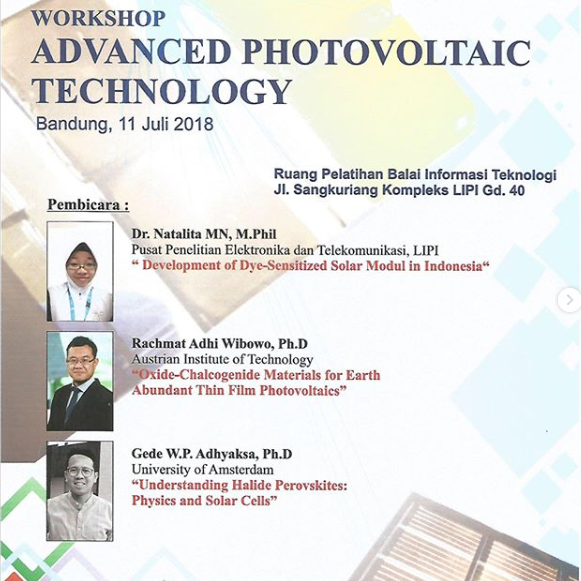
The Advanced Photovoltaic Technology workshop, held on July 11, 2018, at LIPI, Bandung, brought together leading experts to discuss cutting-edge developments in solar energy research with Invited spekear:
1. Dr. Natalita MN, M.Phil from Pusat Penelitian Elektronika dan Telekomunikasi, LIPI
2. Dr. Rachmat Adhi Wibowo from the Austrian Institute of Technology
3. Dr. Gede W.P. Adhyaksa from the University of Amsterdam
Activity in 2020
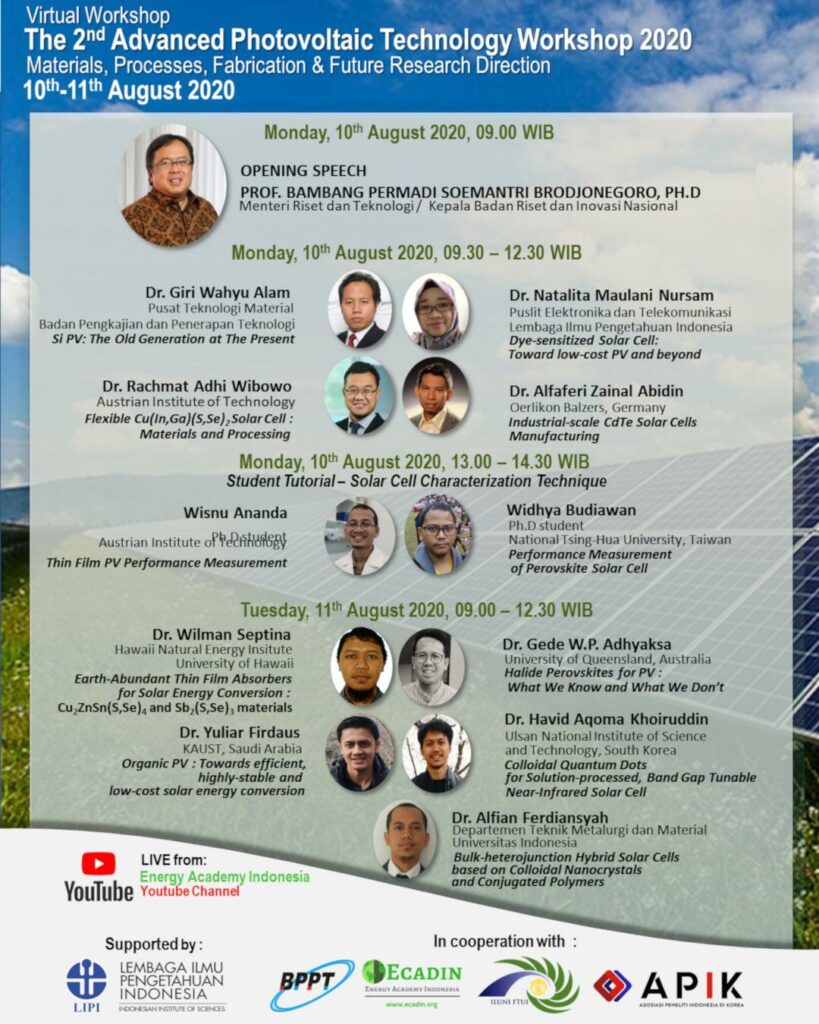
The 2nd Advanced Photovoltaic Technology Workshop 2020, held virtually on August 10–11, 2020, convened leading researchers and industry experts to explore emerging materials, fabrication techniques, and future directions in solar cell technology. The event commenced with an opening speech by Prof. Bambang Permadi Soemantri Brodjonegoro, Ph.D, Minister of Research and Technology and Head of BRIN. Supported by LIPI, BPPT, Ecadin, and Apik, and streamed via Energy Academy Indonesia’s YouTube channel, the workshop fostered interdisciplinary dialogue and strategic collaboration in advancing sustainable photovoltaic research.
Activity in 2023
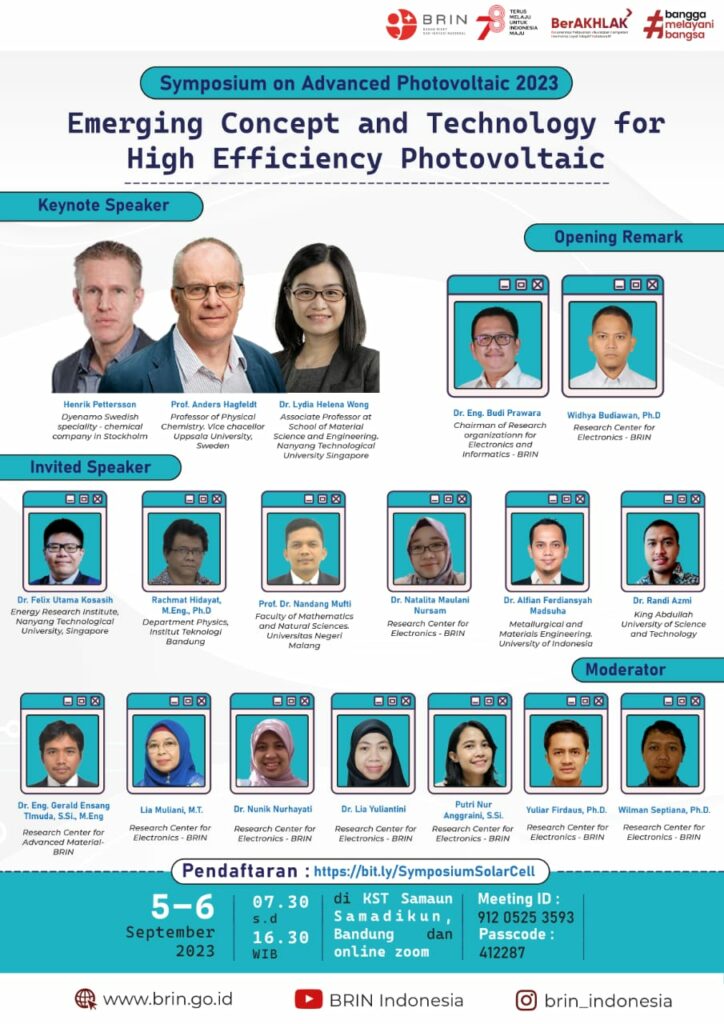
The First Symposium on Advanced Photovoltaic 2023, held on September 5–6, 2023, at KST Samaan Samadikun, Bandung and virtually via Zoom, focused on the theme “Emerging Concept and Technology for High Efficiency Photovoltaic.” Organized by BRIN Indonesia, the event convened global experts and national researchers to discuss cutting-edge advancements in photovoltaic science and technology. Keynote addresses were delivered by Henrik Petersson (Dynamo, Sweden), Prof. Anders Hagfeldt (Uppsala University, Sweden), and Dr. Lylia Helena Wong (Nanyang Technological University, Singapore),
Contact
Research Center for Electronics
Research Organization for Electronics and Informatics
Indonesian National Agency for Research and Innovation Center (BRIN)
BRIN Campus, Jl. Sangkuriang, Cisitu, Bandung, West Java, Indonesia 40135.